Something changed in what prospects compare you to.
A decade ago, a family touring a community was measuring it against a nursing home they remembered visiting, and the bar was mostly about safety and cleanliness. That is no longer the comparison being made. As one senior living architecture firm put it this summer, today's older adults are comparing their options not against nursing homes of the past, but against boutique hotels, wellness resorts, multifamily communities, and lifestyle-driven hospitality experiences.
That is a much harder comparison set. And it explains why so many operators are borrowing their playbook from an entirely different industry.
The Old Debate Has Quietly Ended
For years the industry argued about whether senior living was fundamentally a hospitality business or a healthcare business. That argument appears to be settled, and the answer was both.
Senior Housing News reported in June that the hospitality versus health care debate is seemingly over, with operators in 2026 believing they must offer both to new residents, even at the lower end of the acuity spectrum. The same reporting notes that independent living operators are widening their services to allow for more resident care, including dual-licensing communities so care can be administered in-unit.
So the job got bigger. A community now has to deliver hotel-caliber experience and clinical capability at the same time, to a resident base whose average age in independent living was 80.6 in 2025, per ASHA and ProMatura data.
That is the real story behind the hospitality shift. It is not that care stopped mattering. It is that experience started mattering just as much, and nobody removed anything from the list.
What Thinking Like a Hotelier Actually Means
The phrase gets used loosely, so it is worth being specific. Hoteliers are good at a handful of things senior living has traditionally not had to be good at.
They assume the guest can leave. This is the mindset difference that drives everything else. Customers expect immediate quality, convenience, and support, or they can move out, choose another option, or avoid the industry altogether by staying at home. The alternative of aging at home has never been more viable, which makes every resident a retention question rather than a settled one.
They treat preference as data, not memory. A good hotel knows you want a high floor away from the elevator before you ask. In senior living, the equivalent is knowing that a resident takes her coffee before the dining room opens, avoids shellfish, and has a daughter who visits on Sundays. Hotels systematized that knowledge decades ago. Most communities still keep it in the heads of whoever happens to be working instead of turning it into usable resident insight.
They think in venues, not a dining room. The single large dining hall is being replaced by senior living dining built around choice. Industry reporting notes that multiple dining venues, demonstration kitchens, and wine storage are becoming standard features rather than premium upgrades. As those venues multiply, keeping menus current across every display becomes part of the same operating challenge.
They understand that service recovery is part of service. Hotels plan for things going wrong. The measure of a good one is not that nothing fails, it is what happens in the ten minutes after something does.
The Part Most Operators Underestimate
Here is the finding worth sitting with. When researchers examined what actually drives how residents and families feel about a community, the answer was not the building.
A 2023 study on hospitality factors in retirement communities found that service delivery, social environment, amenities, and the built environment all influence perception, but that interactions with staff were among the strongest drivers of positive or negative sentiment. A related 2024 study found that hospitality practices supporting social connection strongly affected both resident satisfaction and overall life satisfaction.
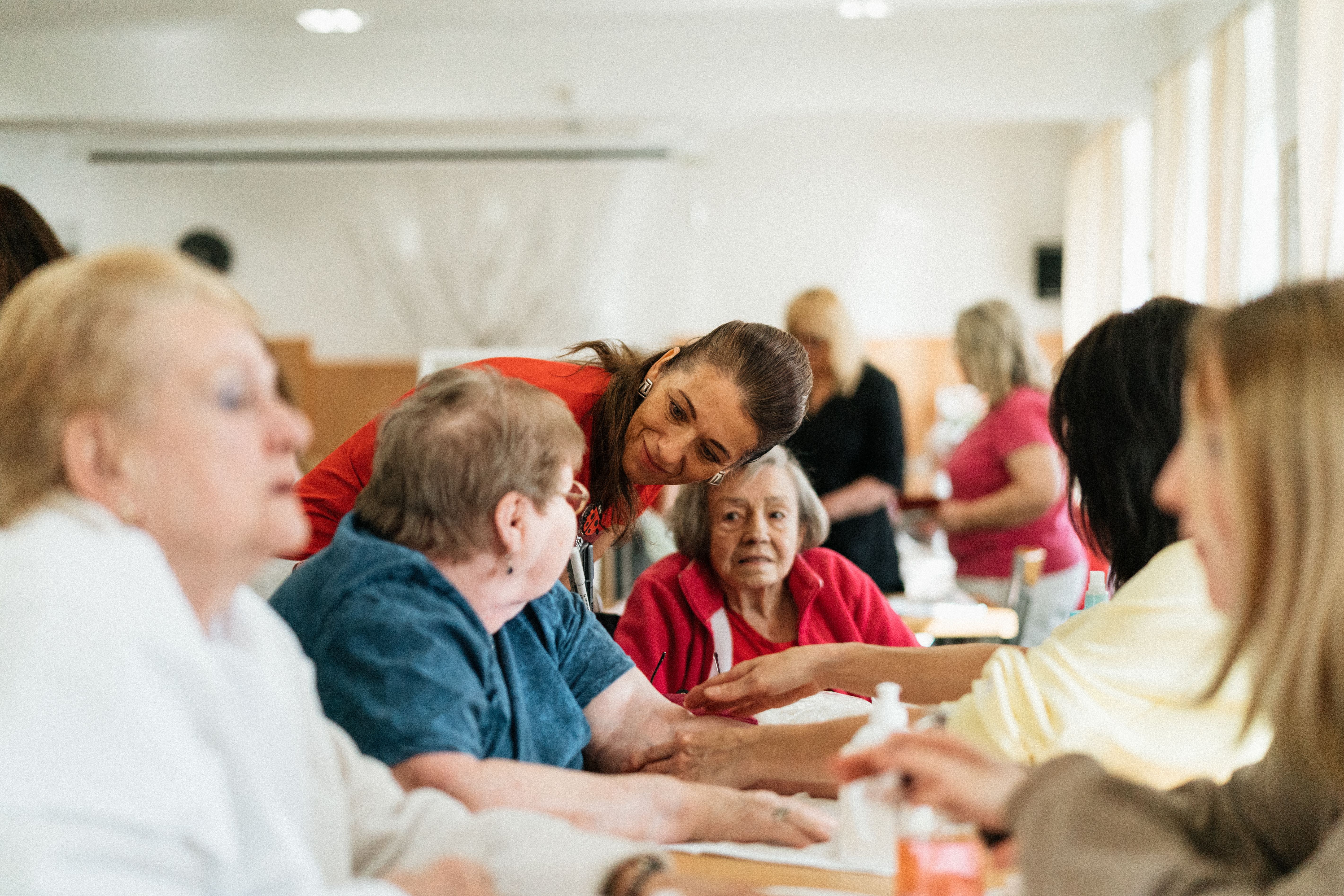
This matters because it reframes what a hospitality investment actually is. A renovation is visible and finite. The daily quality of a hundred small staff interactions is neither, and it is worth more.
It also explains why the operators making real progress are the ones who ask a slightly different question. Not "what amenity should we add," but "what is getting in the way of our team being present with residents."
Hospitality at Scale Is an Operations Problem
This is where the hotelier comparison gets uncomfortable, because the thing hotels are genuinely best at is not decor. It is running a personalized experience at scale, consistently, across shifts and departments and buildings.
Consider what a single resident preference has to survive to actually show up as good service. A dietary restriction recorded at move-in has to reach the main dining room, the bistro, the private dining event on Saturday, and the server covering a shift for someone who called out. A care level change has to reach billing before the statement goes out. A guest joining for dinner has to be handled without the server guessing whether it goes on the resident's account or a credit card.
None of that is a hospitality philosophy problem. It is an information problem. And it is where good intentions usually break down, because the community has all the right information and it is sitting in four systems that were never designed to talk to each other.
Senior living marketers described the challenge in 2026 as combating a "sea of sameness." The interesting thing about that phrase is that the way out of it is rarely a bigger gesture. It is the accumulated effect of a hundred small moments where a resident felt known, and every one of those depends on someone having the right information at the right moment without having to go find it.
Where This Is Heading
The comparison set is not going back. Independent living occupancy surpassed 90% in the third quarter of 2025, and with that demand comes discernment, with older properties proving less appealing to private-pay residents who have options.
The communities that thrive in that environment will be the ones that treat hospitality as an operating discipline rather than an aesthetic. That means personalization that survives a shift change, service that holds up on a Tuesday when two people called out, and a team that spends its energy on residents instead of on reconciling systems.
The hotel industry figured out that consistent, personalized service at scale is a systems achievement, not a talent one. Senior living is arriving at the same conclusion, and the operators who get there first will be the ones families notice.
If you want to see how the Genesis Platform connects dining, care, billing, and resident information so preferences follow residents across every venue, take a look.
Experience Genesis Platform Now
Or if you would rather walk through where personalization breaks down in your own operation, request a discovery call and we will look at it together.
Sources: Senior Housing News, June 2026; ASHA and ProMatura resident data, 2025; retirement-community hospitality research reviewed by MyLifeSite, 2023 and 2024; Provider Magazine senior living trends, 2026; NIC MAP independent living occupancy data, 2025.