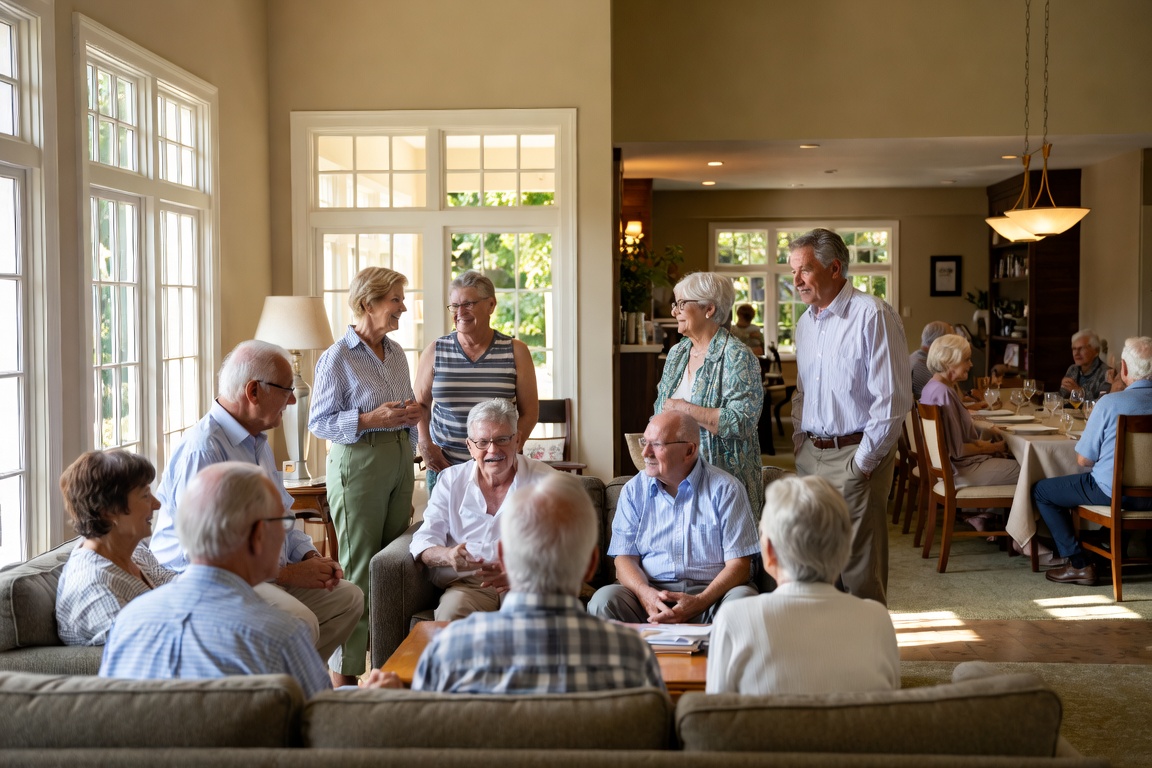
Ask any senior living marketing team what drives move-ins and you will hear about location, pricing, care quality, and amenities. Those factors matter. But the latest research reveals something that should reshape how every community positions itself: social connection is the single most important reason older adults choose to move into a senior living community.
Not the dining program. Not the fitness center. Not even the quality of clinical care. Connection.
If your community is not intentionally building, nurturing, and protecting its social ecosystem, you are losing residents to competitors who are.
The Data Is Clear
Recent wellbeing and longevity research published in 2026 found that social interaction is the number one reason older adults choose senior living. Communities with strong social ecosystems consistently show higher satisfaction scores and better health outcomes than those without them.
This is not a soft metric. Social connection has a direct, measurable impact on nearly every outcome operators care about — occupancy, retention, satisfaction, referrals, and even clinical results.
The World Health Organization has recognized social isolation and loneliness as a global public health priority. Approximately one in six people worldwide experience loneliness, and among older adults the numbers are even more concerning. Research from Washington University found that 70 percent of residents in senior housing communities reported being moderately or severely lonely, even when they were surrounded by other people.
Being in a community does not automatically mean being connected. That distinction is everything.
Why Connection Matters More Than Amenities
The senior living industry has spent the last two decades in an amenity arms race. Bigger fitness centers. Nicer dining rooms. Resort-style common areas. These investments are not wasted, but they miss a fundamental truth about what actually drives resident satisfaction.
A beautiful dining room means nothing if the resident eats alone every night. A state-of-the-art fitness center is irrelevant if nobody uses it together. A gorgeous lobby is just an empty room if residents pass through it without speaking to each other.
Amenities create the setting. Social connection creates the experience. And the experience is what families remember, what residents talk about, and what drives the word-of-mouth referrals that fill beds.
Research consistently shows that greater loneliness and less informal social support are associated with worse self-rated physical health, worse mental health, and lower life satisfaction among seniors. On the other side, older adults with strong social ties report higher levels of well-being, lower rates of depression, and even reduced hospital admissions. A meta-analysis of over 300,000 older adults found that social isolation was associated with a 37 percent increase in inpatient care utilization.
When residents feel connected, they stay healthier, stay longer, and tell their families the community is worth the investment. When they feel isolated, they decline faster, families lose confidence, and your occupancy suffers.
The Loneliness Paradox in Senior Living
Here is the uncomfortable truth: many residents move into senior living communities specifically to combat loneliness, only to find themselves still lonely after they arrive.
This is the loneliness paradox. Proximity does not equal connection. Living near other people is not the same as living with them. Having access to group activities is not the same as feeling included in a community.
The residents who thrive are not just the ones who attend activities. They are the ones who feel known. They have someone who remembers their name, asks about their grandchildren, knows they prefer tea over coffee, and notices when they do not show up for Tuesday book club.
That level of personal recognition used to depend entirely on individual staff members who happened to be naturally warm and observant. When those staff members left, the connection often left with them. The institutional knowledge walked out the door and new staff had to start from scratch.
This is one of the most underrecognized consequences of high turnover in senior living. It is not just an operational problem. It is a connection problem. Every time a beloved caregiver leaves, residents lose a relationship that took months to build.
What Connected Communities Do Differently
The communities that consistently rank highest in resident satisfaction and occupancy share common characteristics when it comes to social connection.
They design for interaction, not just function. The physical layout of the community either encourages or discourages social connection. Wide hallways with seating nooks invite conversation. Dining rooms with flexible seating arrangements allow residents to choose who they eat with. Common areas positioned along natural walking paths create opportunities for spontaneous encounters. The most connected communities treat their physical space as a social architecture, not just a floor plan.
They program for purpose, not just entertainment. There is nothing wrong with bingo night, but the most connected communities go deeper. They offer opportunities for residents to contribute, teach, mentor, and lead. They create interest-based groups that give residents something to belong to, not just something to attend. Residents who feel they have a role in the community are dramatically more engaged than those who are simply presented with a schedule of activities.
They track connection the way they track clinical outcomes. Most communities track medication schedules, fall incidents, and weight changes with precision. Very few track social engagement with the same rigor. The connected communities do. They know which residents attend group activities, which ones eat alone frequently, which ones have had visitors recently, and which ones are showing signs of withdrawal. They treat declining social engagement as an early warning sign, not an afterthought.
They use technology to enhance connection, not replace it. This is where the industry is evolving fastest. Communities are adopting tools that help staff remember resident preferences, flag changes in engagement patterns, and maintain continuity of care even when individual staff members change. The goal is not to automate relationships. It is to ensure that the knowledge and attention that make residents feel known does not disappear when a shift ends or a team member moves on.
They train staff to connect, not just serve. The difference between a good community and a great one often comes down to how staff interact with residents beyond their defined duties. The best communities train staff to make eye contact, use residents names, ask meaningful questions, and recognize behavioral changes. These micro-interactions are the foundation of social connection. They cost nothing to implement and they transform the resident experience.
The Role of Families in the Connection Equation
Social connection in senior living is not just about what happens inside the community. It extends to how families feel about their involvement and access.
Families who feel connected to the community — who receive regular updates, who feel welcomed when they visit, who trust that their loved one is known and cared for — become the most powerful marketing asset a community can have. They refer friends. They leave positive reviews. They renew without hesitation.
Families who feel disconnected — who have to call multiple times to get an update, who feel like their parent is just a room number, who sense that nobody really knows their loved one — do the opposite. They pull their family member out. They warn others. They leave reviews that damage your reputation for years.
The communities that understand this invest in family communication as seriously as they invest in resident programming. Regular updates. Easy access to staff. Transparent information about daily activities, meals, and health status. When families feel included in the social ecosystem, everyone benefits.
The Technology Shift
The latest research shows that 65 percent of current senior living residents and 61 percent of future residents want technology integrated into their wellbeing tracking. But the research also comes with a critical caveat: technology should enhance independence without replacing human connection. It should reduce staff burden without adding complexity.
The industry is moving toward what some researchers call technology with empathy — tools that deepen understanding while preserving dignity. These are not systems that replace the caregiver's role. They are systems that make the caregiver's role more effective by capturing and retaining the knowledge that makes residents feel known.
When a new staff member can walk into a resident's room already knowing their preferences, their family situation, their daily routines, and their personality, the connection starts faster and runs deeper. That continuity is what transforms a senior living community from a place where people live into a place where people belong.
Connection Is Your Competitive Advantage
In a market where occupancy is climbing toward 90 percent and new supply remains constrained, the operators who thrive will not be the ones with the newest buildings or the longest amenity lists. They will be the ones who create communities where residents genuinely feel connected, known, and valued.
Social connection is not a program you add. It is a culture you build. It shows up in how your staff greets residents in the morning, how your dining team remembers dietary preferences, how your activities director notices when someone stops attending, and how your technology retains the institutional knowledge that keeps relationships intact through staff transitions.
The research is unambiguous. Connection is the number one reason seniors choose a community. It is also the number one reason they stay.
The question is not whether your community has a social program. The question is whether your residents actually feel connected. If you are not sure, it might be time to ask them.